Introduction
Higher education plays a vital role in shaping individuals, strengthening communities, and supporting the development of modern society. In a world influenced by technology, globalization, scientific discoveries, and changing career opportunities, education beyond high school has become increasingly valuable. Colleges, universities, and other higher education institutions help students develop specialized knowledge, practical skills, critical thinking abilities, and the confidence needed to face real-world challenges.
Higher education is not only about earning a degree or securing a well-paying job. It is also about personal growth, social responsibility, innovation, and lifelong learning. It allows individuals to explore new ideas, understand different perspectives, and contribute positively to their communities.
Although higher education may not be the right path for everyone, it provides important opportunities for people who want to pursue professional careers, develop their abilities, or gain advanced knowledge in a particular field. Understanding its importance can help students and families make informed decisions about their educational futures.
1. Improving Career Opportunities
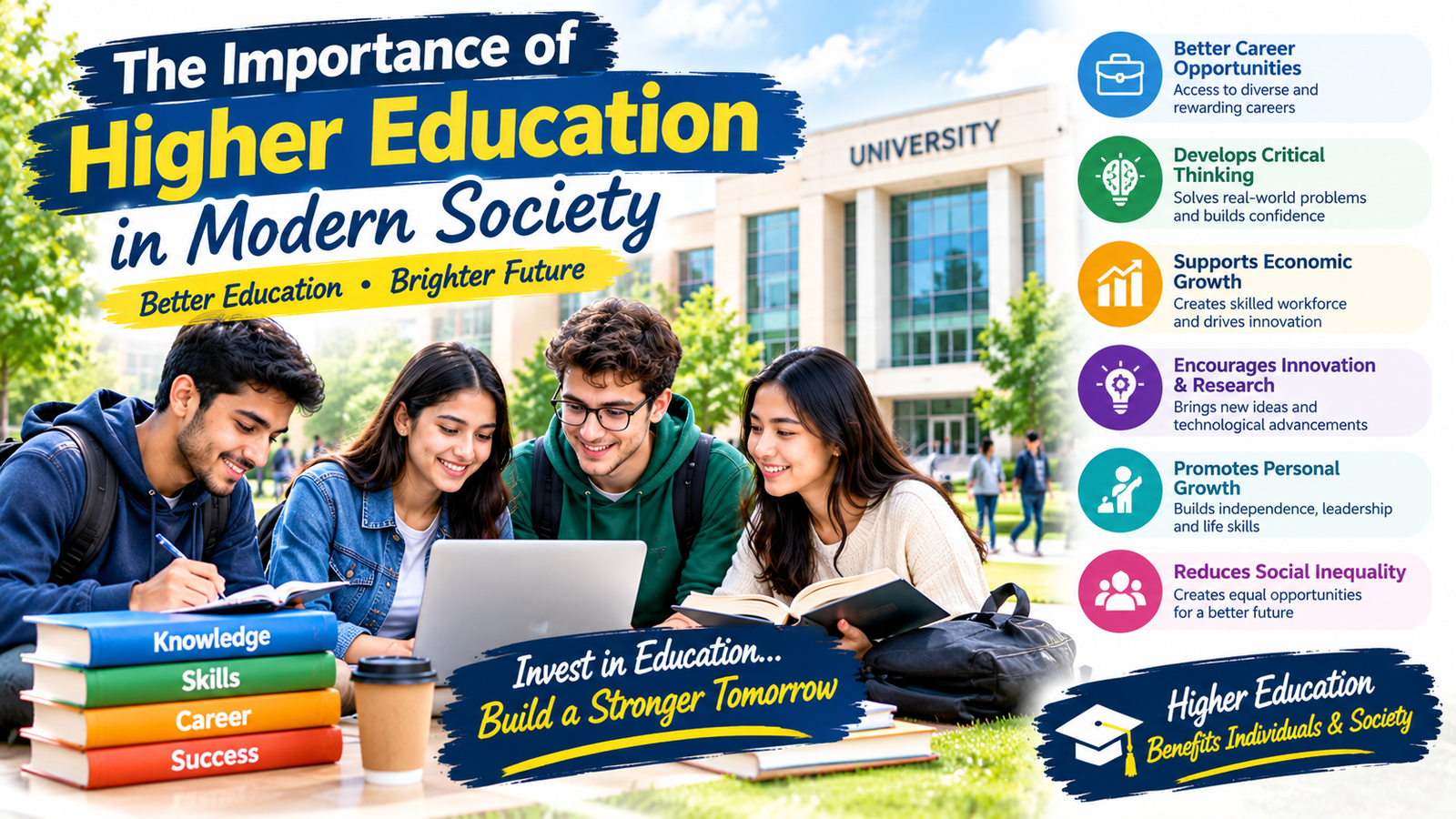
One of the most recognized benefits of higher education is the opportunity to access a wider range of career options. Many professions require specialized qualifications, including medicine, engineering, teaching, law, scientific research, and certain areas of information technology.
A college or university education helps students gain the academic foundation and technical knowledge necessary for these careers. Through lectures, assignments, laboratory activities, projects, and internships, students can develop skills that are relevant to professional workplaces.
Higher education can also help graduates qualify for positions with greater responsibility. Employers often look for candidates who can communicate effectively, solve problems, work in teams, and understand complex information. These abilities can be developed through academic study and practical learning experiences.
However, earning a degree does not automatically guarantee employment. Career success also depends on experience, communication skills, professional behavior, industry demand, and continuous development. Students can improve their employment prospects by combining education with internships, work experience, networking, and relevant certifications.
2. Developing Critical Thinking and Problem-Solving Skills
Modern society faces complicated challenges involving healthcare, environmental protection, economic development, technology, and public policy. Addressing these issues requires people who can evaluate information carefully and make informed decisions.
Higher education encourages students to think beyond memorization. Instead of simply repeating facts, learners are often asked to analyze evidence, compare different viewpoints, evaluate arguments, and develop independent conclusions.
For example, a science student may investigate the causes of a particular environmental problem, while a business student may analyze why a company is experiencing financial difficulties. Both activities require logical reasoning and the ability to identify possible solutions.
These skills are useful far beyond academic settings. They help people evaluate news reports, understand financial decisions, recognize misleading information, and approach personal or professional problems more effectively.
Critical thinking also encourages intellectual independence. Students learn that complex questions may have several possible answers and that strong conclusions should be supported by reliable evidence.
3. Supporting Economic Growth and Development
Education contributes to economic development by preparing individuals to participate productively in the workforce. When people acquire specialized knowledge and useful skills, they can help businesses, public institutions, and other organizations improve their services and performance.
Higher education also supports industries that depend on research, technical expertise, and innovation. Universities educate healthcare professionals, engineers, scientists, teachers, business leaders, and other specialists who help communities function and grow.
A skilled workforce can attract investment, improve productivity, and support the development of new industries. For developing countries, expanding access to quality education can help strengthen local economies and create opportunities for future generations.
Higher education can also encourage entrepreneurship. Students who learn about finance, management, marketing, technology, or product development may use that knowledge to establish businesses and create employment opportunities.
Nevertheless, the economic benefits of education depend on several factors, including the quality of teaching, the availability of suitable jobs, the cost of education, and the connection between academic programs and labor market needs. Educational institutions and employers must work together to ensure that graduates develop relevant skills.
4. Encouraging Innovation and Scientific Research
Innovation is essential to progress in modern society. Many advances in medicine, engineering, agriculture, communication, and renewable energy depend on research and experimentation.
Universities often provide environments where researchers and students can investigate unanswered questions, test new ideas, and develop practical solutions. Research projects can lead to improved technologies, more effective treatments, better farming methods, and new approaches to environmental protection.
Higher education also teaches students how to conduct research responsibly. They learn to collect information, examine evidence, follow ethical standards, and communicate their findings clearly.
For example, researchers may investigate ways to make solar energy more affordable or develop agricultural methods that use less water. Their work can help address challenges that affect communities around the world.
Innovation does not happen exclusively in universities, but higher education institutions can provide the facilities, expertise, collaboration, and research opportunities needed to support it.
5. Promoting Personal Growth and Confidence
Higher education can contribute significantly to personal development. Students often encounter new responsibilities, unfamiliar ideas, and different social environments during their college or university years.
Managing assignments, preparing presentations, participating in group projects, and meeting deadlines can help students become more organized and independent. These experiences may also improve their ability to communicate, make decisions, and manage their time.
University life can expose students to people with different experiences, cultures, interests, and perspectives. Through respectful discussion and collaboration, learners can develop greater confidence in expressing their ideas while becoming more willing to consider alternative viewpoints.
Higher education can also encourage self-discovery. Students have opportunities to explore their interests, identify their strengths, and reconsider their long-term goals.
Personal growth does not happen automatically simply because someone attends college. Students benefit most when they actively participate in learning, seek feedback, explore opportunities, and reflect on their experiences.
6. Reducing Social Inequality Through Educational Opportunities
Access to quality education can help create opportunities for people from different economic and social backgrounds. Students who gain the qualifications required for professional careers may improve their financial circumstances and contribute to the well-being of their families.
Scholarships, grants, affordable public universities, and financial assistance programs can help students who might otherwise struggle to pay for higher education. These programs are especially important for learners from low-income households and communities with limited educational resources.
Higher education can also support greater participation in professions and leadership positions among groups that have historically faced barriers to opportunity.
However, educational inequality remains a serious challenge. Tuition fees, transportation costs, limited internet access, family responsibilities, and differences in school quality can prevent talented students from continuing their studies.
To make higher education more inclusive, governments, institutions, and communities can invest in financial support, accessible learning facilities, career guidance, and programs that help students succeed after enrollment.
Equal access does not mean that every person must attend university. Instead, it means that individuals should have fair opportunities to pursue further education when it matches their interests, abilities, and goals.
7. Improving Digital Literacy and Technological Skills
Technology influences almost every area of modern life, from communication and banking to healthcare, manufacturing, and education. As digital tools become more common, students need the skills to use them effectively and responsibly.
Higher education institutions increasingly incorporate digital learning platforms, online research databases, specialized software, and virtual collaboration tools into their programs.
Students may learn to analyze data, create digital presentations, use industry-specific applications, or work with emerging technologies. These experiences can prepare them for workplaces where technological knowledge is an important advantage.
Digital literacy also involves understanding online privacy, evaluating the credibility of websites, recognizing misinformation, and using technology ethically.
As artificial intelligence and automation continue to change professional activities, the ability to learn new tools and adapt to technological developments is becoming increasingly important.
Educational institutions should therefore help students develop both technical competence and the judgment required to use digital resources responsibly.
8. Building Communication and Leadership Skills
Effective communication is important in nearly every profession. Employees must explain ideas, understand instructions, collaborate with colleagues, and respond professionally to challenges.
Higher education offers many opportunities to develop these abilities. Classroom discussions, written assignments, presentations, debates, and research projects help students communicate information in different formats.
Group assignments can teach students how to divide responsibilities, manage disagreements, and work toward shared objectives. Participation in student organizations, volunteer projects, and campus activities can also provide valuable leadership experience.
Leadership is not simply about giving instructions to others. It involves responsibility, listening, planning, decision-making, and supporting a team.
Students who practice these skills during their education may find it easier to adapt to professional environments and contribute effectively to their organizations.
These abilities are also valuable in everyday life, where clear communication and cooperation can improve relationships and help communities solve shared problems.
9. Creating Greater Awareness of Society and Global Issues
Modern society is increasingly interconnected. Decisions made in one country can influence international trade, environmental conditions, public health, and technological development elsewhere.
Higher education can help students understand these connections by introducing them to history, economics, politics, sociology, science, literature, and other areas of knowledge.
Studying different subjects allows learners to examine social problems from multiple perspectives. They may develop a better understanding of poverty, climate change, cultural differences, public health, and the importance of responsible citizenship.
Universities also bring together students and faculty members with different backgrounds and experiences. This diversity can encourage discussion, cooperation, and mutual respect.
A broader understanding of society may help graduates make more thoughtful decisions in their personal and professional lives. It can also encourage them to participate in community initiatives, volunteer activities, and efforts to improve public well-being.
Education cannot eliminate every form of prejudice or disagreement, but it can provide tools for informed discussion and constructive engagement.
10. Preparing Students for a Changing Job Market
The modern job market changes as industries develop, technologies improve, and consumer needs evolve. Some occupations grow rapidly, while others change significantly or become less common.
Higher education can help students prepare for this changing environment by teaching foundational knowledge, specialized skills, and the ability to learn independently.
Many universities offer opportunities for internships, industry placements, career counseling, research projects, and professional networking. These experiences can help students understand workplace expectations before entering full-time employment.
However, no degree can guarantee that a person will remain prepared for every future development. Graduates may need to learn new software, complete additional training, pursue professional certifications, or change career directions during their working lives.
For this reason, lifelong learning is an important part of modern professional success. People who remain curious and willing to update their knowledge may be better equipped to respond to new opportunities and challenges.
Educational institutions can support this process by offering flexible programs, short courses, online learning, and continuing professional education.
11. Understanding the Financial Value of Higher Education
Higher education can provide financial benefits, but students should consider its costs carefully. Tuition, books, accommodation, transportation, technology, and living expenses can make university attendance expensive.
Graduates in some fields may have access to higher-paying positions, while others may experience lower starting salaries or face limited job opportunities. Financial outcomes vary according to the subject studied, location, experience, industry, and individual career choices.
Before selecting a program, students should research tuition fees, available scholarships, expected career paths, employment trends, and the potential need for student loans.
Comparing different institutions can help families make realistic decisions. A lower-cost program with strong teaching and relevant professional opportunities may sometimes be a better choice than a more expensive alternative.
Students should also consider the non-financial value of education, including intellectual development, personal confidence, professional connections, and the ability to contribute to society.
A thoughtful decision involves balancing educational goals with financial circumstances rather than assuming that every degree will produce the same economic results.
12. The Role of Universities in Community Development
Universities can contribute to the communities around them through education, research, public services, and partnerships with local organizations.
For example, healthcare departments may organize health awareness programs, education students may support literacy initiatives, and environmental researchers may help communities understand local pollution challenges.
Universities can also provide training opportunities for local businesses, support new entrepreneurs, and share research findings that help improve public services.
Community engagement allows students to apply classroom knowledge to practical situations. It can also help them understand the responsibilities that come with professional expertise.
When educational institutions collaborate with schools, businesses, nonprofit organizations, and public agencies, they can help address local needs more effectively.
These partnerships demonstrate that higher education is not isolated from society. Its value can extend beyond individual graduates to families, workplaces, and entire communities.
13. Challenges Associated With Higher Education
Despite its benefits, higher education faces several challenges. The cost of tuition is one of the most significant barriers, particularly for students who do not have access to scholarships or financial support.
Another challenge is the gap that can sometimes exist between academic programs and employer expectations. Students may graduate with theoretical knowledge but limited practical experience, making it difficult to transition into the workplace.
Some students also experience academic pressure, financial stress, uncertainty about their careers, or difficulty balancing education with family responsibilities.
Educational institutions can address these issues by improving career counseling, expanding internships, offering mental well-being support, providing flexible learning options, and updating course content.
Students also need to take an active role in their educational journey. Seeking guidance, developing practical skills, building professional relationships, and planning finances can help them make better use of available opportunities.
Recognizing these challenges does not reduce the importance of higher education. Instead, it highlights the need to make educational systems more affordable, relevant, inclusive, and supportive.
14. Choosing the Right Higher Education Path
Not every student needs to follow the same educational route. Universities, community colleges, technical institutes, vocational schools, and online programs can serve different goals.
Students should consider their interests, abilities, career ambitions, financial circumstances, and preferred learning environment before choosing a program.
Researching course content, faculty qualifications, accreditation, internship opportunities, graduate outcomes, and total costs can help learners compare institutions.
It is also useful to speak with teachers, career advisers, current students, and professionals working in a field of interest. Their experiences may provide practical information that is not obvious from a university website.
Some careers require a traditional university degree, while others may be accessible through vocational training, apprenticeships, industry certifications, or a combination of different qualifications.
The best path is one that supports a student’s goals while providing meaningful learning opportunities and realistic future options.
Conclusion
Higher education plays an important role in modern society by developing knowledge, improving career opportunities, supporting innovation, and encouraging personal growth. It can help individuals become skilled professionals, thoughtful citizens, and active contributors to their communities.
Its benefits extend beyond employment and income. Higher education can strengthen critical thinking, communication, digital literacy, leadership, and awareness of global challenges. It can also support economic development and provide opportunities for students who might otherwise face barriers to professional advancement.
At the same time, higher education is not without challenges. Rising costs, unequal access, and changing workplace demands require careful attention from students, institutions, employers, and governments.
The value of higher education is greatest when it combines quality teaching, practical experience, responsible research, and a commitment to lifelong learning.
Ultimately, education should be viewed as an investment in both individuals and society. By expanding access to relevant and affordable learning opportunities, communities can prepare people to face modern challenges, explore new possibilities, and contribute to a more knowledgeable and prosperous future.