SEO Title: Why Reading Is Important for Students: Top Benefits
Focus Keyword: Why Reading Is Important for Students
Meta Description: Discover why reading is important for students and how regular reading improves vocabulary, creativity, knowledge, critical thinking, academic performance, and communication skills.
Suggested URL Slug: why-reading-is-important-for-students
Introduction
Reading is one of the most valuable habits students can develop during their educational journey. It is not only a way to learn new information but also an essential activity that supports intellectual development, creativity, communication, and personal growth. Whether students read textbooks, novels, newspapers, educational articles, or digital content, every meaningful reading experience can contribute to their understanding of the world.
In today’s fast-paced digital environment, students often spend considerable time watching videos, browsing social media, and consuming short-form content. Although digital technology provides many educational opportunities, developing a consistent reading habit remains important. Reading encourages students to concentrate, explore ideas, understand different perspectives, and develop the skills needed for academic and professional success.
The importance of reading extends beyond classroom learning. It helps students become independent thinkers, confident communicators, and lifelong learners. By reading regularly, students can strengthen their vocabulary, improve their imagination, gain knowledge, and learn how to evaluate information carefully.
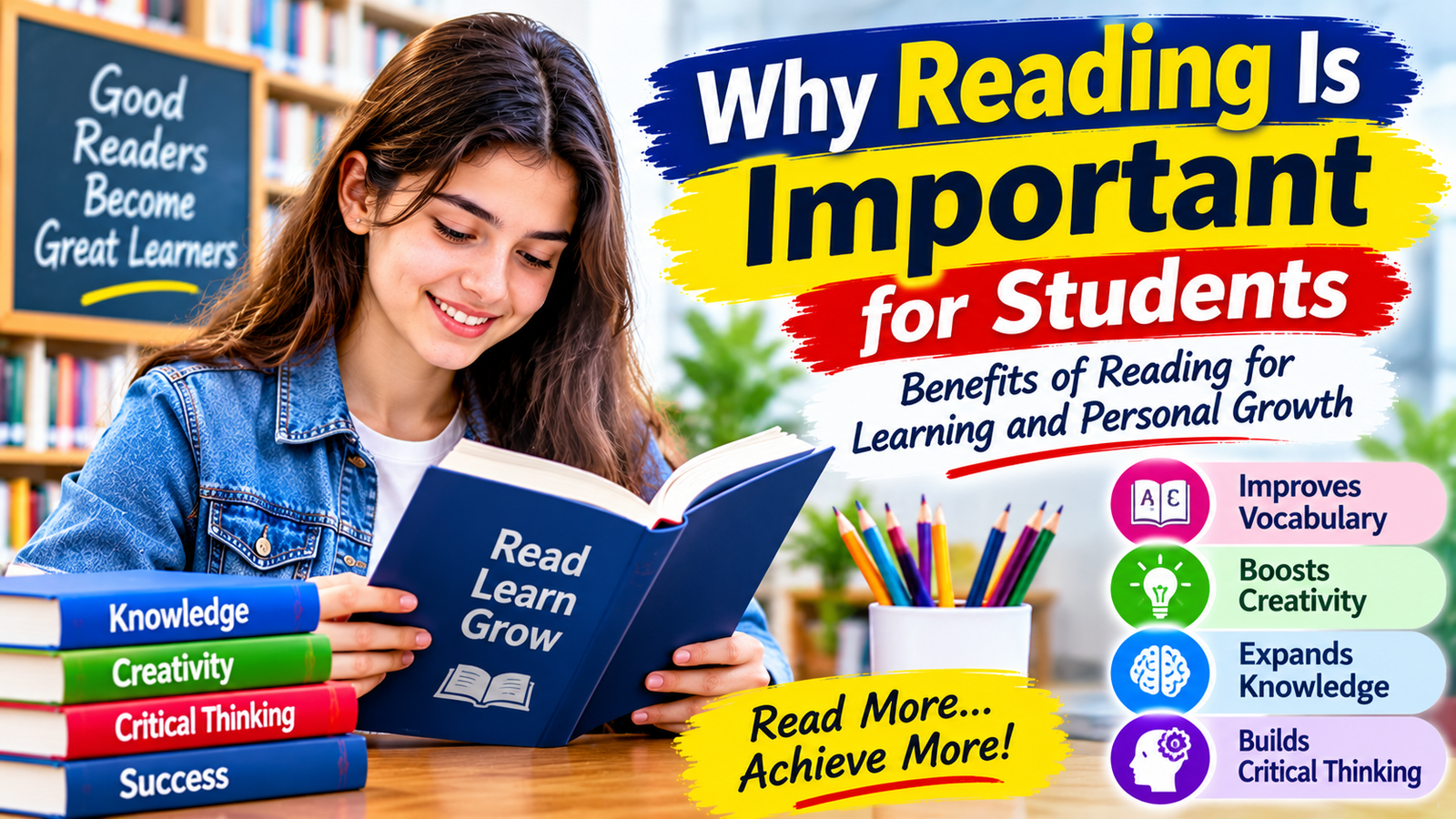
This article explores why reading is important for students and explains how it contributes to vocabulary development, creativity, knowledge, critical thinking, academic performance, and personal growth.
1. Reading Improves Vocabulary and Language Skills
One of the most noticeable benefits of reading is the development of vocabulary. Students encounter new words, expressions, sentence structures, and writing styles whenever they read books or educational materials.
Learning vocabulary through reading can be especially useful because students see words in meaningful contexts. Instead of memorizing isolated definitions, they can understand how words are used in sentences and how their meanings change depending on the situation.
For example, a student reading a story about nature may discover words related to weather, landscapes, animals, and environmental conditions. Repeated exposure to these words can gradually improve the student’s ability to recognize and use them.
Reading also strengthens grammar and sentence construction. Students become familiar with different writing patterns, punctuation, and ways of expressing ideas. This knowledge can help them write essays, complete assignments, and communicate more effectively.
A stronger vocabulary can also make classroom discussions easier. Students who understand more words are often better prepared to explain their thoughts, ask questions, and participate in academic conversations.
To improve vocabulary through reading, students should:
- Read books and articles appropriate for their level.
- Notice unfamiliar words and try to understand them from context.
- Keep a vocabulary notebook.
- Use newly learned words in writing and conversation.
- Revisit difficult words regularly.
With consistent practice, reading can become a natural and enjoyable way to develop language skills.
2. Reading Encourages Creativity and Imagination
Reading is a powerful activity for developing imagination. Unlike many forms of entertainment that present complete visual experiences, books often encourage readers to create their own mental pictures.
When students read stories, they imagine characters, locations, events, and situations. They may picture a mysterious forest, a distant planet, a historical city, or a future world. This process encourages the mind to explore possibilities beyond everyday experiences.
Creative reading also introduces students to different storytelling styles and ideas. Fiction, fantasy, science fiction, poetry, and biographies can all inspire students to think creatively and explore new interests.
For example, a student who reads a science fiction novel may become interested in astronomy, robotics, or space exploration. Another student may discover a passion for writing after reading an engaging story.
Reading can also support creative problem-solving. Stories often present characters facing challenges and making difficult decisions. Students can imagine alternative solutions, predict outcomes, and consider what they might do in similar situations.
Creativity is valuable not only in artistic activities but also in science, technology, business, and everyday life. Students who develop imaginative thinking may become more comfortable exploring new ideas and approaching problems from different perspectives.
3. Reading Expands Knowledge and Understanding
Reading provides students with access to information about subjects they may never encounter directly. Through books and educational materials, students can explore history, science, geography, culture, technology, health, and many other topics.
A student interested in ancient civilizations can learn about historical societies through books. Someone curious about the environment can explore climate, wildlife, and conservation. Reading allows students to investigate these subjects at their own pace and revisit information whenever necessary.
This broadens their understanding of the world and helps connect classroom lessons with real-life experiences.
Reading also exposes students to different cultures, traditions, and lifestyles. Stories and informative texts can introduce readers to people whose experiences are different from their own. This can encourage curiosity, respect, and a greater appreciation of diversity.
However, students should remember that not every source contains accurate information. Developing knowledge requires choosing reliable books, educational websites, and trustworthy publications.
By reading widely and thoughtfully, students can build a strong foundation of knowledge that supports their education and future interests.
4. Reading Develops Critical Thinking Skills
Critical thinking is the ability to examine information, evaluate evidence, recognize assumptions, and make reasoned decisions. Reading can help students develop these important skills.
When students read, they do more than recognize words. They interpret meaning, connect ideas, identify arguments, and consider whether information makes sense.
For example, when reading a news article, students can ask:
- What is the main message?
- Who created this content?
- What evidence supports the claims?
- Is the information presented fairly?
- Are there other perspectives to consider?
These questions encourage students to become thoughtful readers rather than accepting every statement without examination.
Reading stories can also strengthen critical thinking. Students may analyze characters’ motivations, identify conflicts, predict outcomes, and consider the consequences of decisions.
Nonfiction reading offers additional opportunities to compare facts, examine explanations, and understand cause-and-effect relationships.
In the modern world, critical thinking is especially important because students regularly encounter large amounts of information online. The ability to evaluate sources and recognize misleading claims can help them make more informed decisions.
5. Reading Supports Academic Performance
Reading is closely connected to success in many school subjects. Students who understand written information can often approach assignments, textbooks, and examination questions with greater confidence.
Strong reading comprehension helps students understand what a question is asking. This is important in subjects such as mathematics, science, history, and social studies, where students must interpret instructions and explanations.
Reading also supports independent learning. Students can use textbooks, educational guides, research articles, and reference materials to explore difficult concepts outside the classroom.
For example, if a student finds a science topic confusing during a lesson, reading a clear explanation from another source may provide a different perspective and improve understanding.
Regular reading can also help students become familiar with academic language. This may make it easier to understand complex passages, prepare written assignments, and participate in discussions.
Reading alone does not guarantee high grades. Academic achievement also depends on teaching quality, practice, motivation, study habits, and other factors. Nevertheless, reading provides an important foundation for learning across many subjects.
6. Reading Improves Concentration and Focus
Reading requires students to direct their attention toward a particular subject for a period of time. This can help them practice concentration and reduce the habit of constantly switching between activities.
When students read a book or detailed article, they must follow the sequence of ideas, remember important information, and understand how different sections connect.
This process encourages sustained attention.
In contrast, frequently switching between notifications, videos, and short pieces of content may interrupt the reading experience and make it harder to remain focused on one task.
Students can develop better reading concentration by choosing a quiet environment, setting aside a specific reading period, and gradually increasing the amount of time they spend reading.
Even fifteen or twenty minutes of regular reading can provide a useful starting point for building a consistent habit.
7. Reading Strengthens Communication Skills
Effective communication is essential for students in classrooms, social situations, and future careers. Reading can help develop both written and spoken communication.
Books and articles expose students to different ways of organizing thoughts and presenting information. They learn how authors introduce topics, explain ideas, support arguments, and conclude discussions.
These examples can influence students’ own writing.
Reading can also improve speaking skills by expanding vocabulary and helping students become more comfortable expressing ideas. Students who read about a variety of subjects may find it easier to participate in discussions and explain their opinions.
Reading stories can introduce dialogue, tone, and emotional expression. Informative texts can demonstrate how to communicate facts clearly and logically.
Students can strengthen communication by reading regularly and discussing what they have learned with classmates, teachers, friends, or family members.
8. Reading Builds Empathy and Emotional Understanding
Reading can help students understand emotions, relationships, and human experiences. This is particularly true when they explore stories involving characters with different backgrounds, challenges, and perspectives.
A novel may describe a character experiencing friendship, disappointment, courage, loneliness, or personal change. By following the character’s experiences, readers can consider how other people might feel in similar situations.
This can encourage empathy and emotional awareness.
Reading biographies and personal accounts can also help students understand the experiences of people who have overcome challenges or contributed to society.
These lessons may encourage students to become more patient, respectful, and thoughtful in their relationships.
Although reading is not a replacement for real-life social interaction, it can provide valuable opportunities to reflect on human behavior and different viewpoints.
9. Reading Encourages Independence and Lifelong Learning
Students who develop reading habits can become more independent learners. Instead of relying entirely on classroom explanations, they can use books and other resources to answer questions and explore topics on their own.
This ability becomes increasingly valuable as students progress through school, college, and university.
Independent reading encourages curiosity. A student who discovers an interesting topic may continue exploring it through additional books, articles, or educational resources.
Reading also supports lifelong learning. Education does not end when students graduate. People continue learning new skills, understanding changing technologies, and exploring different interests throughout their lives.
A strong reading habit can help students remain curious and adaptable in a changing world.
10. How Students Can Develop a Regular Reading Habit
Although reading offers many benefits, some students find it difficult to read regularly. They may feel busy with schoolwork, struggle to concentrate, or believe that reading is boring.
The good news is that reading habits can be developed gradually.
Start With Interesting Topics
Students should begin with books and articles that match their interests. Someone who enjoys sports may prefer biographies of athletes or sports-related stories. Students interested in technology may enjoy science books or articles about inventions.
Reading becomes easier to maintain when the subject is enjoyable.
Set Realistic Reading Goals
Students do not need to read an entire book every day. A small, achievable goal can be more effective than an unrealistic schedule.
For example, students might begin with ten pages a day or fifteen minutes of reading. Once the habit becomes comfortable, they can gradually increase their reading time.
Create a Reading Schedule
Choosing a regular reading time can make the habit easier to maintain. Students may read before school, during a break, or before going to bed.
A consistent schedule helps reading become part of everyday life.
Explore Different Types of Reading Materials
Students should not feel limited to traditional textbooks. They can explore novels, biographies, magazines, educational websites, poetry, and nonfiction books.
Different reading materials provide different experiences and help students discover what they enjoy most.
Discuss What You Read
Talking about books with friends, teachers, or family members can make reading more engaging.
Students can share favorite characters, discuss interesting facts, or explain what they learned. These conversations may also improve comprehension and communication.
Reduce Distractions
A quiet reading environment can help students concentrate. Keeping unnecessary notifications away and choosing a comfortable place may make reading more enjoyable.
The goal is not to eliminate technology but to use it thoughtfully while making time for focused reading.
11. The Role of Parents and Teachers in Encouraging Reading
Parents and teachers play an important role in helping students develop positive reading habits.
Parents can encourage reading by providing books, visiting libraries, reading together with younger children, and showing interest in what students are learning.
Teachers can introduce engaging reading materials, organize classroom reading activities, and allow students to explore subjects that interest them.
Schools can also support reading through libraries, book clubs, reading challenges, and opportunities for students to share book recommendations.
It is important to remember that students have different reading abilities and interests. Encouragement and suitable reading materials can help make reading a positive experience rather than a stressful responsibility.
When reading is supported at home and school, students may be more likely to develop a lasting interest in books and learning.
Conclusion
Reading is an essential habit that supports students in many areas of life. It improves vocabulary, strengthens language skills, encourages creativity, expands knowledge, and develops critical thinking. Reading can also support academic performance, concentration, communication, empathy, and independent learning.
In a world filled with information and constant digital distractions, the ability to read carefully and understand what is written remains extremely valuable.
Students do not need to begin with difficult books or long reading sessions. Starting with interesting materials and setting small daily goals can help them build a sustainable habit.
By making reading a regular part of their lives, students can strengthen their educational foundation, discover new interests, and prepare themselves for future opportunities.
Ultimately, reading is more than a school activity. It is a lifelong skill that helps students understand the world, develop their abilities, and continue learning long after their formal education has ended.