
 Introduction
 Introduction
Higher education can create valuable opportunities for students who want to develop their knowledge, improve their skills, and build successful careers. However, the cost of attending a university or college can be a significant challenge for many individuals and families. Tuition fees, accommodation, textbooks, transportation, and other educational expenses can make it difficult for students to continue their studies without financial support.
University scholarships offer an important way to reduce these financial challenges. They provide eligible students with funding that can help cover some or, in certain cases, all of their educational expenses. Unlike many traditional loans, scholarships generally do not require repayment, provided recipients comply with the award’s terms and conditions.
Learning how to apply for university scholarships can help students identify suitable opportunities and prepare stronger applications. From researching scholarship programs to writing personal statements and meeting deadlines, every stage of the process requires careful planning.
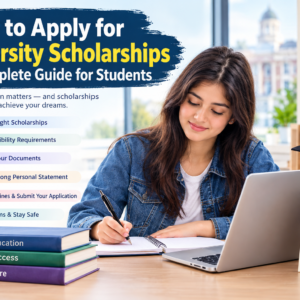
This comprehensive guide explains how students can find scholarships, understand eligibility requirements, prepare application documents, avoid common mistakes, and improve their chances of receiving financial assistance.
Understanding University Scholarships
A university scholarship is a financial award provided to eligible students to support their education. Scholarships may be offered by universities, government agencies, charitable foundations, private organizations, businesses, and other funding institutions.
Different scholarships have different objectives. Some recognize outstanding academic achievement, while others support students with financial difficulties, exceptional talents, leadership experience, or specific career interests.
Scholarships may cover full tuition fees, a percentage of tuition costs, or a fixed financial amount. Certain programs may also contribute toward accommodation, books, research expenses, transportation, or living costs.
Before applying, students should carefully examine what each scholarship covers. An award described as fully funded may have specific conditions, and some programs provide tuition assistance without covering everyday living expenses.
Understanding these differences helps applicants make realistic financial plans and choose opportunities that match their needs.
Step 1: Identify Your Educational Goals
The first step in applying for scholarships is understanding your educational objectives. Students should consider which subject they want to study, which qualification they hope to earn, and which institutions offer suitable programs.
For example, a student interested in technology may research computer science or information technology degrees. Someone interested in business may explore accounting, management, marketing, or finance programs.
Having a clear academic direction makes it easier to identify scholarships designed for particular subjects, degree levels, or career pathways.
Students should also consider whether they plan to study in their home country or abroad. International scholarships may have additional requirements involving language proficiency, travel documents, academic recognition, and visa eligibility.
Creating a list of preferred institutions and degree programs provides a practical starting point for scholarship research.
Step 2: Research Available Scholarship Opportunities
Once educational goals are clear, students can begin searching for relevant scholarships. Reliable information is essential because application requirements, deadlines, funding amounts, and eligibility rules vary widely.
University websites are among the most useful places to start. Many institutions publish information about undergraduate scholarships, graduate funding, international student awards, and financial assistance programs.
Government education departments may also announce scholarship opportunities for domestic and international students. In addition, charitable foundations, nonprofit organizations, and professional associations sometimes provide financial support for students pursuing specific fields.
When researching a scholarship, applicants should record the following information:
- Scholarship name and sponsoring organization.
- Eligible degree programs and academic levels.
- Minimum academic requirements.
- Financial eligibility conditions, if applicable.
- Required application documents.
- Application opening and closing dates.
- Funding amount and covered expenses.
- Conditions for renewing the scholarship.
Maintaining this information in a spreadsheet or organized document can help students compare opportunities and avoid missing important deadlines.
Applicants should prioritize official sources and verify unfamiliar scholarship announcements before sharing personal information or paying any fees.
Step 3: Check the Eligibility Requirements
Every scholarship has its own eligibility criteria. Meeting these requirements is usually necessary before an application can be considered.
Academic performance is a common factor. Some scholarships require a particular grade average, examination score, or previous qualification. Others consider leadership, community service, artistic ability, athletic achievement, or professional experience.
Financial circumstances may also influence eligibility for need-based scholarships. In these cases, students might need to provide evidence of household income or other financial information.
International scholarships can have additional conditions, such as citizenship requirements, residency restrictions, age limits, language test results, or admission to an approved university.
Applicants should read all eligibility conditions carefully before preparing a detailed application. Applying for a scholarship without meeting its essential requirements can waste time and effort.
If any requirement is unclear, students should contact the official scholarship provider for clarification.
Step 4: Prepare Your Application Documents
Preparing documents in advance can make the application process more organized and less stressful. Although requirements differ between scholarship programs, several documents are commonly requested.
Academic Transcripts and Certificates
Academic transcripts show a student’s educational history, grades, and completed courses. Applicants may also need copies of school certificates, college diplomas, or previous university degrees.
Documents should be accurate, readable, and issued by the appropriate educational institution. Some scholarship providers require certified copies or official translations.
Personal Statement
A personal statement explains who the applicant is, what they hope to achieve, and why the scholarship would be valuable.
Students should describe their educational interests, relevant achievements, personal motivation, and future goals. A strong statement connects these experiences to the scholarship’s purpose.
Instead of using vague claims, applicants should provide specific examples that demonstrate their commitment, determination, and suitability for the opportunity.
Recommendation Letters
Some scholarships require letters from teachers, professors, employers, or other qualified individuals who know the applicant’s academic abilities or personal qualities.
Students should approach potential recommenders early and explain the scholarship’s objectives and submission requirements. Providing a résumé, academic summary, or list of achievements can help recommenders write a more informed letter.
Résumé or Curriculum Vitae
A résumé may be requested to demonstrate academic accomplishments, volunteer work, employment history, extracurricular activities, leadership, and relevant skills.
Applicants should keep their résumé organized and focus on experiences that relate to the scholarship criteria.
Financial Documents
Need-based scholarships may require financial records, income statements, or other documents demonstrating financial circumstances.
Applicants should submit only the information requested through legitimate application channels and follow the provider’s privacy and document-handling instructions.
Step 5: Write a Strong Scholarship Personal Statement
The personal statement is often an important part of a scholarship application because it allows students to explain their goals beyond grades and certificates.
A well-written statement should clearly explain why the applicant has chosen a particular field, what experiences influenced that decision, and how the scholarship could support their educational progress.
Students should begin with a clear introduction that establishes their academic interests. The main section can discuss relevant achievements, challenges overcome, extracurricular involvement, or experiences that demonstrate persistence.
The conclusion should connect the student’s education to realistic future goals.
For example, an applicant interested in education might explain how studying teaching methods could help them contribute to better learning opportunities in their community. A technology student might describe an interest in developing useful digital solutions.
Applicants should avoid copying generic statements from the internet. Their writing should reflect their own experiences, motivations, and plans.
Before submitting the statement, students should check grammar, spelling, clarity, word limits, and the specific instructions provided by the scholarship organization.
Step 6: Meet All Application Deadlines
Scholarship deadlines are important because many organizations do not accept late applications. Missing a deadline may result in rejection, even when an applicant has excellent qualifications.
Students should create a calendar containing the opening and closing dates for each scholarship. They should also set reminders for recommendation letters, entrance examinations, language tests, and document preparation.
Submitting an application several days before the deadline can provide extra time to resolve technical problems or correct missing information.
Applicants should also determine whether scholarship applications are separate from university admission applications. Some institutions require students to secure admission before applying for funding, while others allow both applications to proceed simultaneously.
Understanding this relationship can help students plan their application schedule more effectively.
Step 7: Complete the Application Carefully
After preparing the required documents, applicants should complete the scholarship form according to the official instructions.
Personal details, academic information, contact information, and supporting documents should be accurate and consistent. Names and dates should match the relevant official records.
Students should answer every required question and ensure that uploaded files use acceptable formats and meet any size restrictions.
Before submission, applicants should review the complete application from beginning to end. They should confirm that all required documents are attached, recommendation letters have been arranged correctly, and the personal statement follows the requested format.
Where possible, applicants should save a copy of the submitted application and retain the confirmation email or reference number.
These records can be useful when checking application status or communicating with the scholarship office.
Step 8: Avoid Scholarship Scams
Students searching for financial assistance should remain alert to fraudulent scholarship offers. Some dishonest websites or individuals promise guaranteed awards in exchange for upfront payments or sensitive personal information.
Applicants should be cautious when a provider guarantees approval, creates unusual pressure to pay immediately, or uses an unofficial communication channel without verifiable organizational details.
Before applying, confirm that the scholarship exists and that the sponsoring organization can be independently verified. Use official university or government websites whenever possible.
Students should never provide passwords, banking login credentials, or unnecessary sensitive information to an unverified provider.
An application fee does not automatically prove that a scholarship is fraudulent, but unexpected payment demands should be investigated carefully. Applicants should verify any legitimate fee through the official organization’s published policies before paying.
Step 9: Prepare for Scholarship Interviews
Some scholarship programs include interviews as part of their selection process. Interviews allow reviewers to learn more about an applicant’s academic interests, achievements, character, and future plans.
Students can prepare by reviewing the scholarship’s objectives and reflecting on why they are suitable candidates.
Common interview questions may include:
- Why did you choose this field of study?
- What are your most important academic achievements?
- How would this scholarship help you reach your goals?
- What challenges have you overcome in your education?
- How do you hope to contribute to your community or profession?
Applicants should practice giving clear, honest answers supported by relevant examples. They should also prepare questions about the program if the interviewer provides an opportunity.
Professional communication, punctuality, and familiarity with the application can help students approach interviews with greater confidence.
Step 10: Understand the Scholarship Award Conditions
Receiving a scholarship is an important achievement, but students should understand the award conditions before accepting it.
Some scholarships require recipients to maintain a minimum grade average, enroll in a full course load, complete a specific degree program, or participate in certain academic activities.
Other awards may be limited to one academic year and require a new application for renewal.
Students should carefully review the award letter to understand payment arrangements, eligible expenses, renewal criteria, and any circumstances that could affect continued funding.
If a scholarship covers only part of the educational cost, applicants should calculate the remaining amount and develop a realistic budget.
Understanding these conditions can help students maintain eligibility and avoid unexpected financial difficulties.
Common Scholarship Application Mistakes
Several avoidable mistakes can weaken an otherwise promising application.
One common problem is applying without checking eligibility requirements. Another is submitting incomplete documents or ignoring instructions about word limits and file formats.
Generic personal statements may also fail to explain why a student is suitable for a particular scholarship. Applicants should tailor each statement to the opportunity instead of submitting exactly the same text everywhere.
Late applications, inaccurate information, and poor proofreading can create additional problems.
Students should also avoid exaggerating achievements or providing misleading financial information. Honesty is essential throughout the application process.
A careful final review can help applicants identify errors and present their qualifications clearly.
Conclusion
Applying for university scholarships requires research, organization, patience, and attention to detail. Students who understand their educational goals, identify suitable opportunities, check eligibility requirements, and prepare strong supporting documents can approach the process more confidently.
A successful application should communicate academic motivation, relevant achievements, personal goals, and a clear understanding of how financial assistance would support the student’s education.
Applicants should begin early, track deadlines, use official information sources, and review every submission carefully. They should also remain alert to fraudulent offers and understand the conditions attached to any scholarship they receive.
Although scholarship competition can be challenging, a well-planned application strategy helps students explore more opportunities and make informed decisions about their future.
With consistent effort and realistic expectations, students can take meaningful steps toward making higher education more affordable and achieving their long-term academic and professional ambitions.
Ultimately, a scholarship is more than financial assistance. For many students, it can provide the support needed to continue learning, develop valuable skills, and work toward a brighter future.